Published 08/31/26
Changing your number would get you out of the unwanted calls. It disconnects you from whatever lists you're on or the person harassing you that has your number.
However, it's also extremely inconvenient. Think about all the accounts you'll have to update, like banks, doctors, subscriptions, and any two-factor authentication. And then, all the people in your life who have your number that you'll have to let know about the new change.
And after all that, there's no guarantee that this new number won't get unwanted calls eventually as well. It’s not going to stay fresh forever…
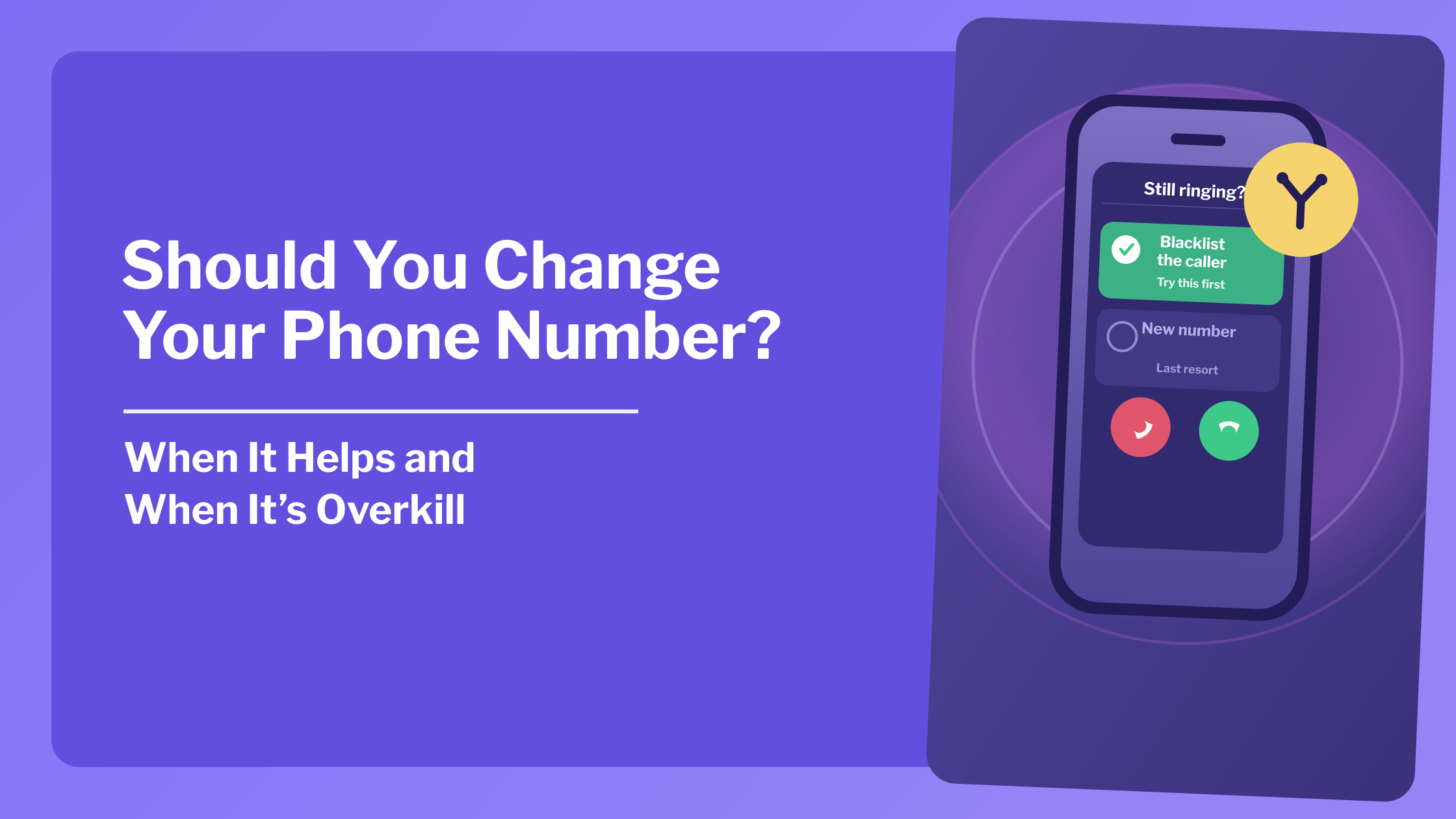
It's an extremely last resort, only worth it in some specific situations.
When does changing your number actually make sense?
It’s worthwhile in a few scenarios:
If you're dealing with a harasser or stalker who has your number specifically. After you try blocking them a few times, if they still manage to reach you then a new number would remove their access from you entirely.
You're on too many lists, and your number is spreading too fast. If all your attempts to opt-out can’t keep up with the calls, you might have no choice but to start over.
If nothing is targeted at you personally and most of the unwanted calls you're getting are generic spam and robocalls, a new number is a bit of overkill. These robocalls will eventually find out your new number as well, and then you'll be back to square one.
What are the real downsides?
When going in, people don’t expect how disruptive it will be.
Any account that you have that gets verified with your phone number will lock you out. That might even be more inconvenient than a few robocalls.
Furthermore, think about all your friends and family. They won’t know how to reach you unless you tell each one of them directly.
Anyways, the long-term benefits aren't even guaranteed. The new number can land up back on lists within a few months.
How do you change your number without losing everything?
If you do decide to change your number, at least do it smartly:
Update your accounts before you switch, not after. Any account with two-factor authentication tied to your number should be updated with your new one before you lose access to your old one. Many times you need access to the original number in order to change it.
Set up call forwarding temporarily, if your carrier offers it. Calls to your old number will be sent to your new one for a transition period until people get used to the switch.
Tell people directly rather than relying on them to notice. A group text to all close contacts works well.
Be more careful with the new number than you were with the old one. Avoid unnecessary forms, use a secondary number for sign-ups, and think twice before sharing it with anyone.
Is there a way to get a new number without changing carriers or plans?
Yes, most carriers let you request a new number on your existing line. You can keep everything on your account and just change the number. (Sometimes they charge a small fee.)
Some people instead keep their original number for personal use and then get a second one for anything public. If you're able to do that, it would avoid the whole disruption of starting over, but maybe you won't get bothered as much. This only works if your primary line is not such a big problem yet.
What if the harassment or unwanted contact is coming from someone specific?
This is serious. If that person is determined enough, they can get a hold of your new number… after you went through the whole process of changing it in order to get away from them.
In such cases, you need something more. What counts as phone harassment covers the legal side of this in more depth, including documentation and when to involve police etc.
Should you try other options first?
Usually, yes, that's the smart path.
Carrier-level spam filtering, blocking, and the National Do Not Call Registry all cost nothing to try, so it’s a good place to start. Once you've done all of that and the calls are still constant, you can consider moving on to the less convenient option of changing a number.
Is there a middle ground between blocking and changing your number?
There really is. You don't have to rely on blocking this number and hoping for the best, and you don't have to start fully from scratch.
CaughtYou blacklists repeat or unwanted callers and sends them straight to a dead line. It all happens silently, so you're not bothered, and permanently.
This solves the problem that a number change is meant to solve without having to update every one of your accounts.
Bottom line
Changing your number is not a myth, but it's quite disruptive to everyday life. Therefore, treat it as a later step instead of a first response. Try blocking and opting out first, then blacklisting, and only change your number if these don't work or if someone specific is trying to get you.