Published 07/22/26
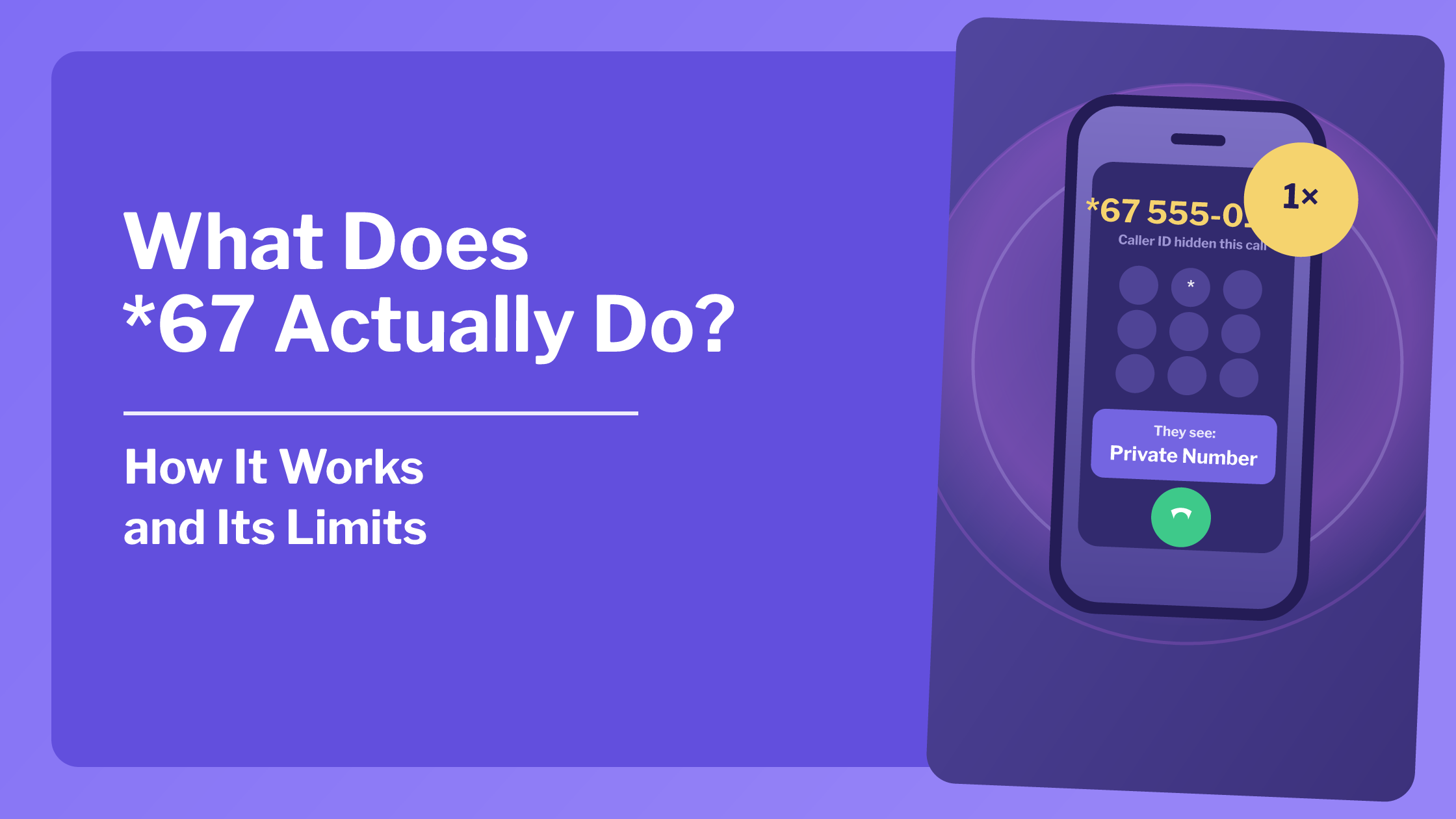
Dialing *67 before a call hides your number from the person you're calling. It makes it come up as "Private Number" or "Blocked" on their screen.
But it only works on that one call. If you were to call them back later, you would have to dial *67 again for it to have the same effect.
It has other limits too; a)it doesn't work on toll-free or emergency numbers, b)some recipients can still see through it depending on their carrier or if they have a special app.
How do you use *67 to hide your number?
It’s simple. Dial 67 followed immediately by the full number you're calling, no pause in between. Just for a visual example, if you’re trying to dial 323-555-2222, just dial 67-323-555-2222.
Your carrier processes the star code and removes your caller ID from that specific outgoing call. Then it connects you as normal otherwise. The person on the other end sees "Private Number," "Blocked," or "No Caller ID," depending on their phone.
Does *67 work on every call?
Honestly, no.
Toll-free numbers (e.g. 800, 888, 877) can see your number regardless of *67. This is because part of the toll-free service is the feature to know who’s calling as well.
11 and other emergency services always see your number too, for safety reasons, obviously. That’s the law.
Then there’s also the businesses that use caller ID systems that simply refuse blocked calls. But in this case you would know, as it asks you to unblock your number before they'll connect you.
Is using *67 permanent?
As mentioned above, *67 does not stay from call to call.
If you want your number hidden for an entire evening of calls, you'd need to dial *67 before each one individually. There's no setting that keeps it on by default.
For that kind of permanent privacy, you'd want to check with your carrier about a standing caller ID block on your line.
Is *67 illegal?
That’s an important question and the answer is no. Using *67 to hide your own number on an outgoing call is completely legal in the US.
The thing that’s illegal is caller ID spoofing done with intent to cause harm, which is a different thing entirely. The main difference is that *67 is just to withhold your number, it doesn’t fake a number. Caller ID spoofing explains the technique scammers actually use, which goes further than simply hiding a number.
Why would someone use *67 on you?
There are plenty of reasons for this, some ordinary and some less ordinary…
A doctor's office might call from a personal cell rather than the main line and prefer not to expose it.
A landlord handling a sensitive matter might do the same.
Your 10-year old nephew might to try using it to play a cute prank.
None of these are such a red flag.
The less ordinary reason is someone who doesn't want to be identified.
That can be a scammer, or maybe someone you know avoiding a conversation.
Can you call back a number that used *67?
Not directly. Your phone never received the number that called so it has no information to redial. There is an option to try using the *69 feature, which can attempt to redial the last incoming call. Yet results aren’t completely consistent, depending on your carrier. A lookup service can also sometimes help, maybe it can still be traceable even if the displayed number was blocked.
Should you ever answer a call that used *67?
That depends on what you're expecting, same as any unfamiliar call.
If you’re in middle of dealing with something that may result in an unknown call, I say it's worth it to answer. But if it’s just a random day with nothing going on, maybe let it go to voicemail and see if they leave a message.
Getting past the "Private Number" screen
The frustrating part of *67 from the receiving end is that it tells you someone chose to hide, but not saying who.
iCaughtYou goes deep, to surface who's actually behind the call, so a "Private Number" screen simply turns back into a name.
If you want the fuller picture on why some calls arrive with no caller ID at all, whether by *67 or otherwise, why do some calls show up as No Caller ID talks about that.
Bottom line
*67 hides your number for one outgoing call at a time, legally and simply. It isn't permanent, though, and it doesn't work on every number you dial.
If you're on the receiving end of a *67 call, it’s just a hidden number with very few ways to find out who it is.